SwissAML
Product Tour
SwissAML guides compliance officers through the full Anti-Money Laundering (AML) lifecycle: document management, client onboarding, compliance readiness tracking, beneficial ownership and screening, risk assessment, regulatory monitoring, audit trail, and suspicious activity reporting. Each step maps to a specific regulatory requirement under the Swiss Anti-Money Laundering Act (AMLA).
1. Document management
Link to your existing systems or use SwissAML as your document store
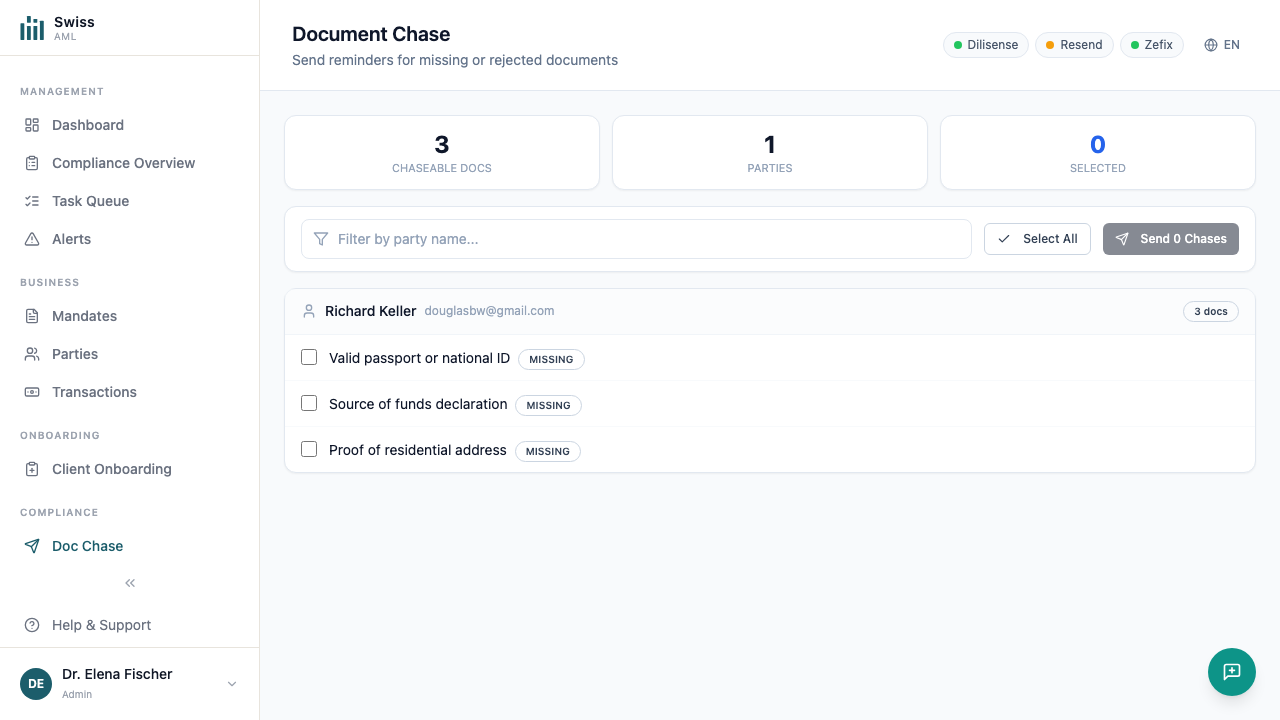
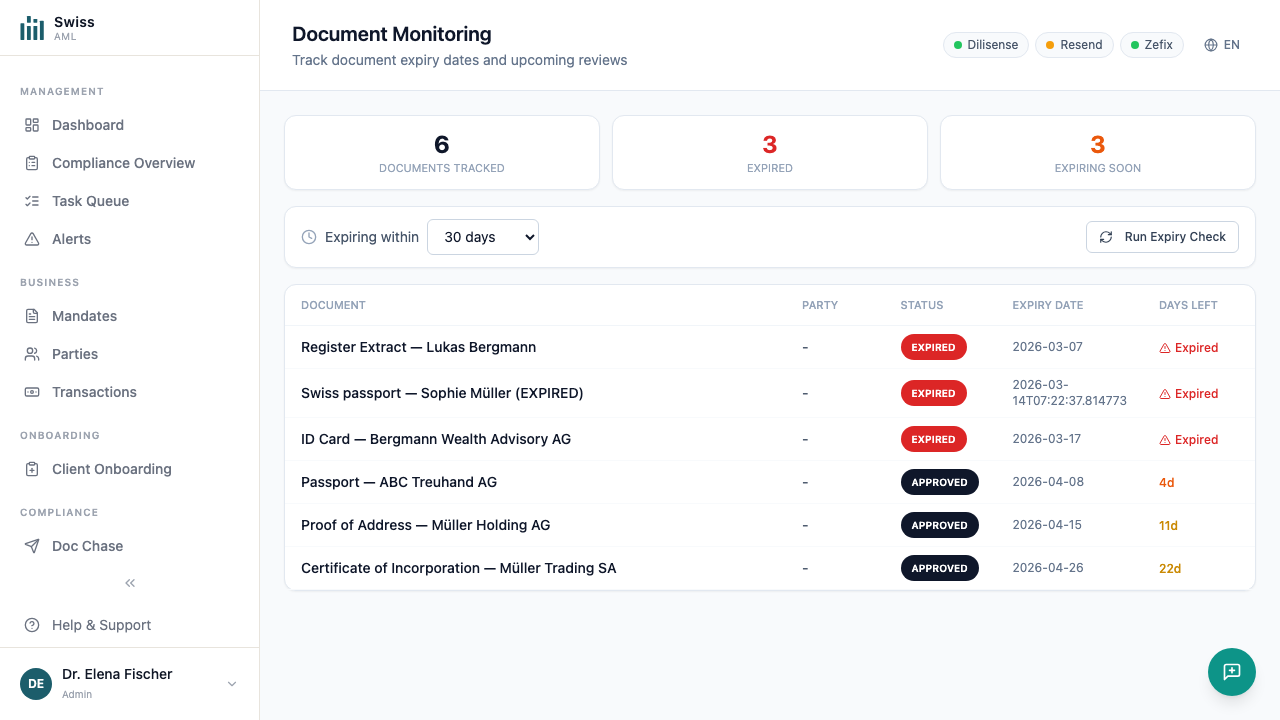
SwissAML connects to your existing document management system — Nextcloud, SharePoint, or other repositories. Documents stay where they are. SwissAML links to them, tracks their compliance status, and records each access in the audit trail. No migration required. Alternatively, use SwissAML as a standalone document store with built-in versioning: every document version is preserved with its approval date and a complete audit history. Document expiry monitoring alerts your team before identity documents, register extracts, or certifications lapse.
Anti-Money Laundering Act (AMLA) Art. 7 →2. Dashboard
Compliance posture at a glance
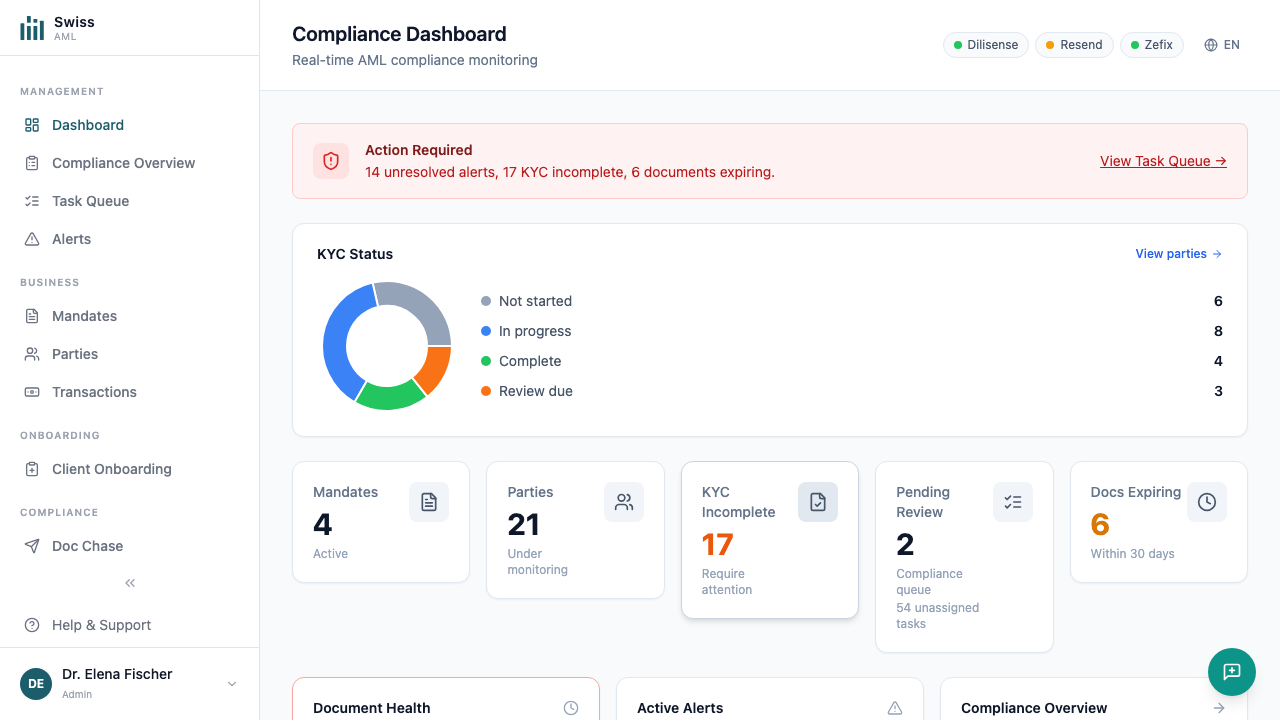
The dashboard shows your firm's compliance posture in real time: open mandates, Know Your Customer (KYC) completion rates, screening alerts, document health, and risk distribution across your portfolio. Clickable indicators link directly to the relevant detail views. Action-required items are surfaced at the top so the compliance officer knows immediately where attention is needed — not buried in a list or hidden behind multiple clicks.
3. Client onboarding and compliance readiness
From first contact to audit-ready — guided at every step
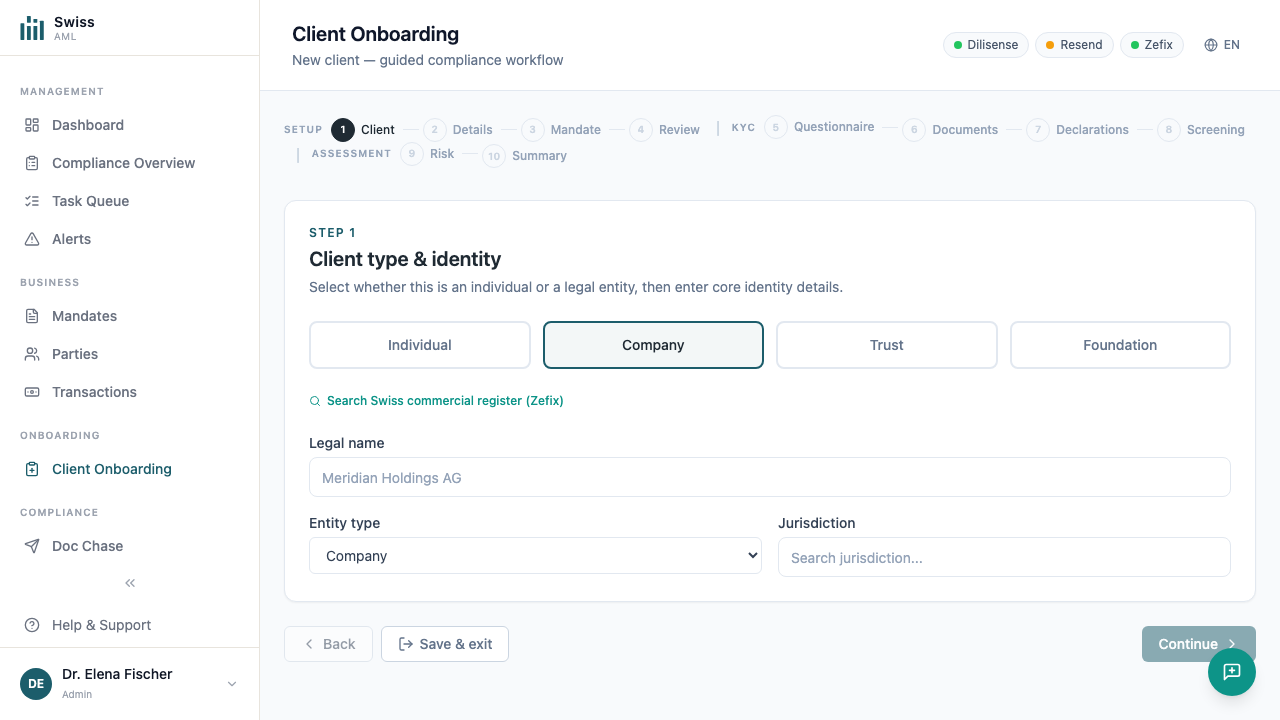
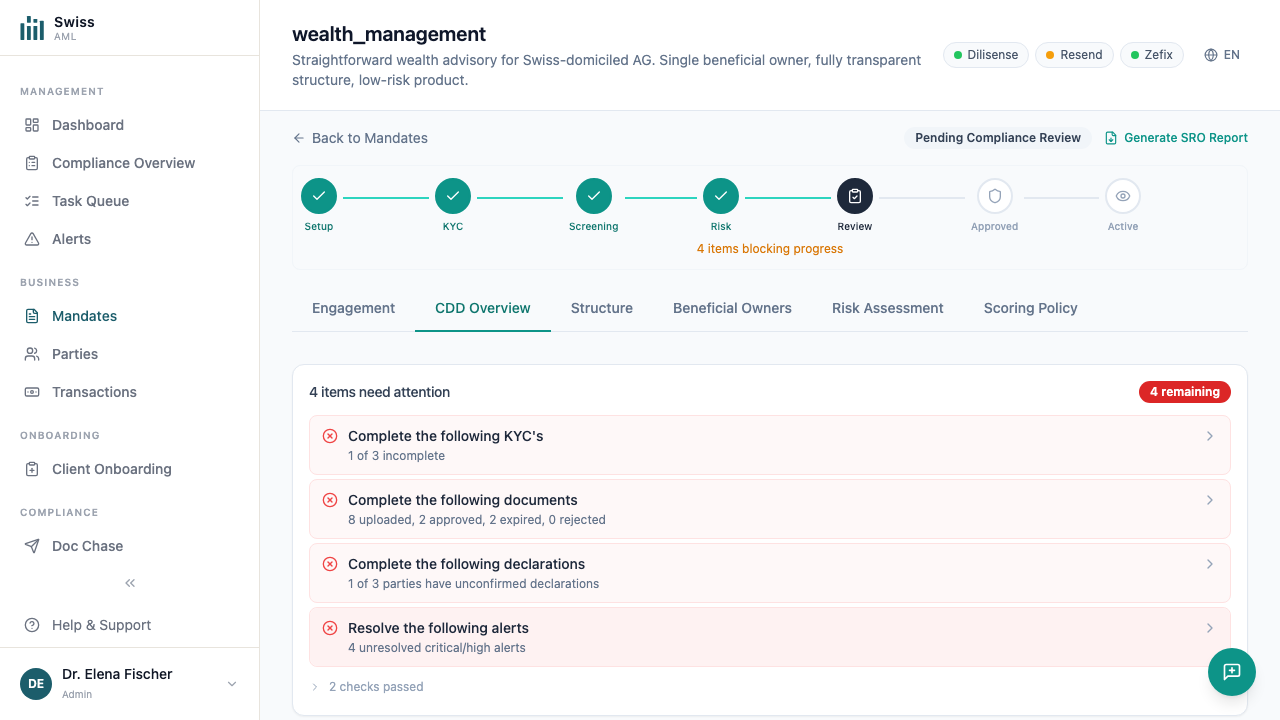
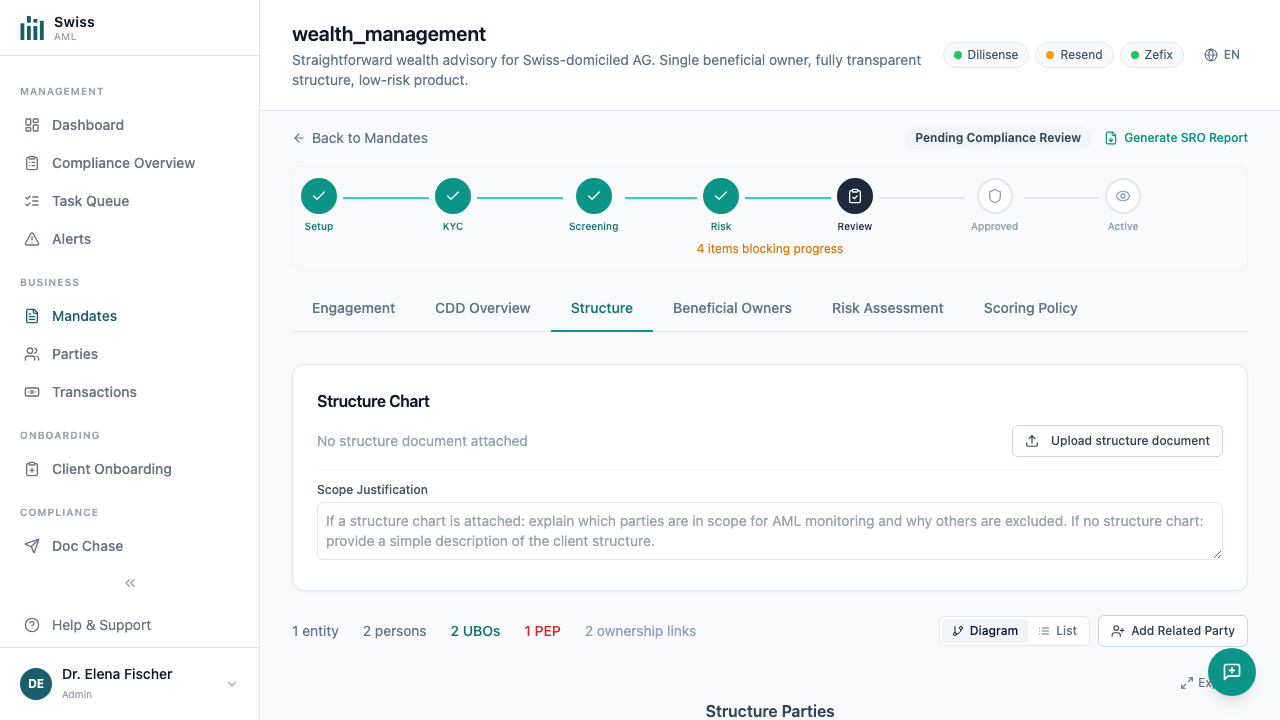
Create a new mandate through the onboarding wizard, add parties, and capture identity information in a consistent format. The Client Due Diligence (CDD) Overview provides an actionable readiness checklist: each compliance requirement is listed with its current status, and every incomplete item links directly to the page where it can be resolved. Required fields are highlighted, documents can be marked as not applicable where appropriate, and declarations are gated on the basis of confirmation. The structure chart visualises the relationship between parties, mandates, and beneficial owners. Seven compliance stages — from onboarding through to active monitoring — track each mandate's progress toward full regulatory readiness.
Anti-Money Laundering Act (AMLA) Art. 3–4 →4. Compliance pipeline and task queue
Track every compliance action across all mandates
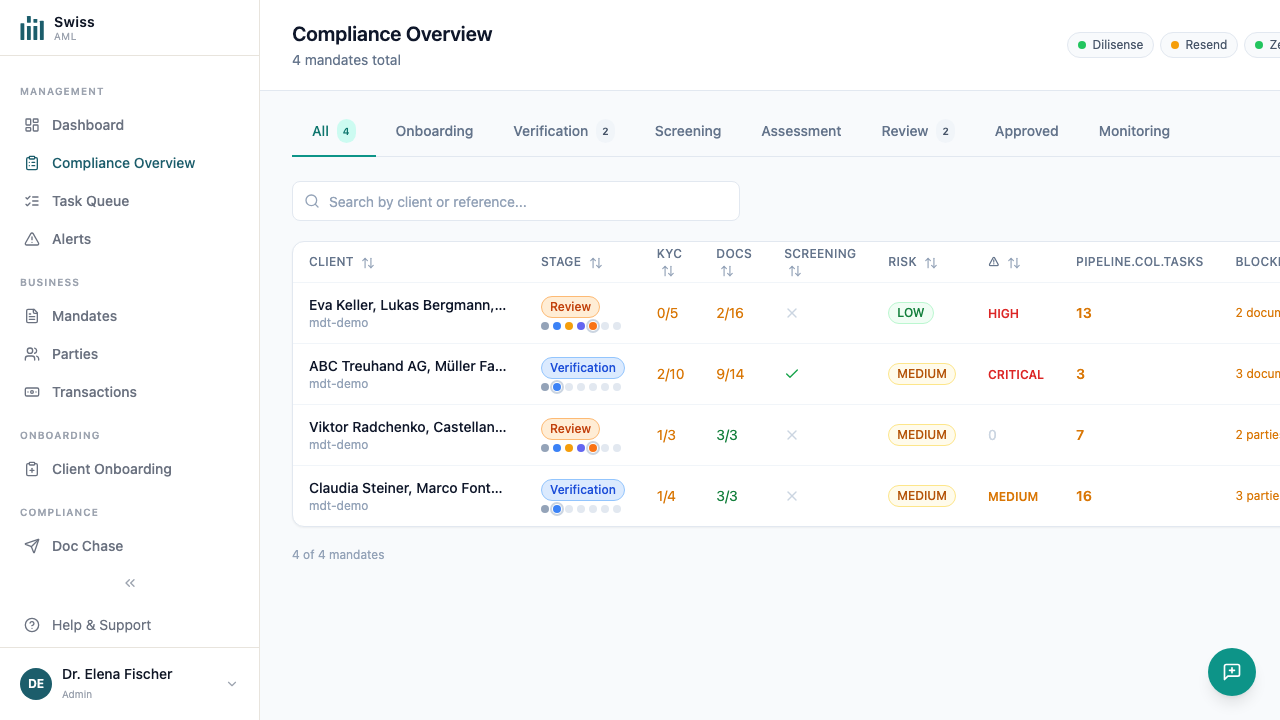
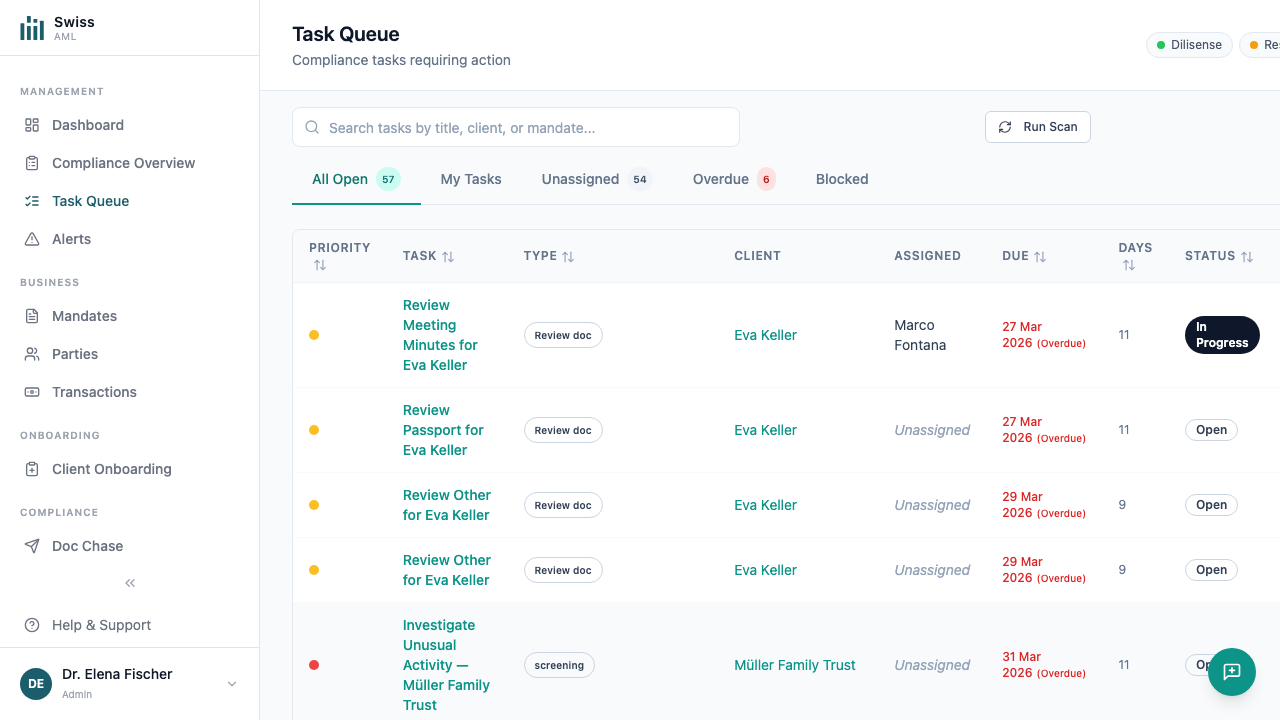
The compliance pipeline provides a single view of every mandate in your firm, showing its current stage, Know Your Customer (KYC) progress, document status, screening results, risk level, and any blocking issues. The task queue tracks individual compliance actions: missing documents, incomplete Know Your Customer (KYC) reviews, screening hits requiring follow-up, risk assessments pending approval, and overdue periodic reviews. Tasks are auto-generated from compliance events, assigned to the responsible officer, and linked directly to the item that needs attention. Priority, service-level tracking, and overdue indicators keep complex, long-running compliance processes on track across your entire portfolio.
5. Beneficial ownership and screening
Map ownership, screen automatically, monitor continuously
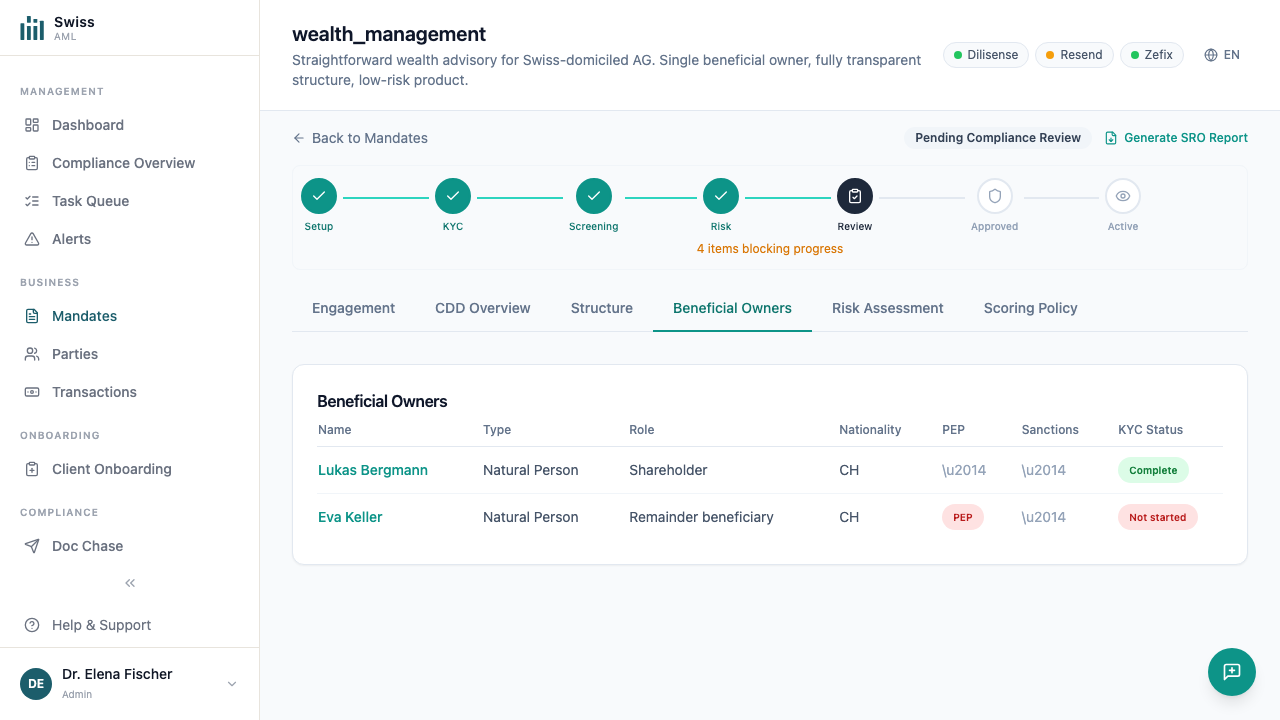
Map the ownership and control structure visually. Add beneficial owners with ownership percentages and control basis. We apply the Swiss 25% threshold and flag control through means other than ownership. Live screening runs against Office of Foreign Assets Control (OFAC), European Union (EU), United Nations (UN), and State Secretariat for Economic Affairs (SECO) sanctions lists via Dilisense integration. Politically Exposed Person (PEP) checks, sanctions checks, and adverse media screening are integrated into the compliance workflow — not a separate tool or manual process. Screening results are recorded in the audit trail and linked to the relevant party for ongoing monitoring.
Anti-Money Laundering Act (AMLA) Art. 4 / Financial Action Task Force (FATF) Recommendations 24–25 →6. Registers
Politically Exposed Person (PEP), Sanctions, and Adverse Media — searchable and auditable
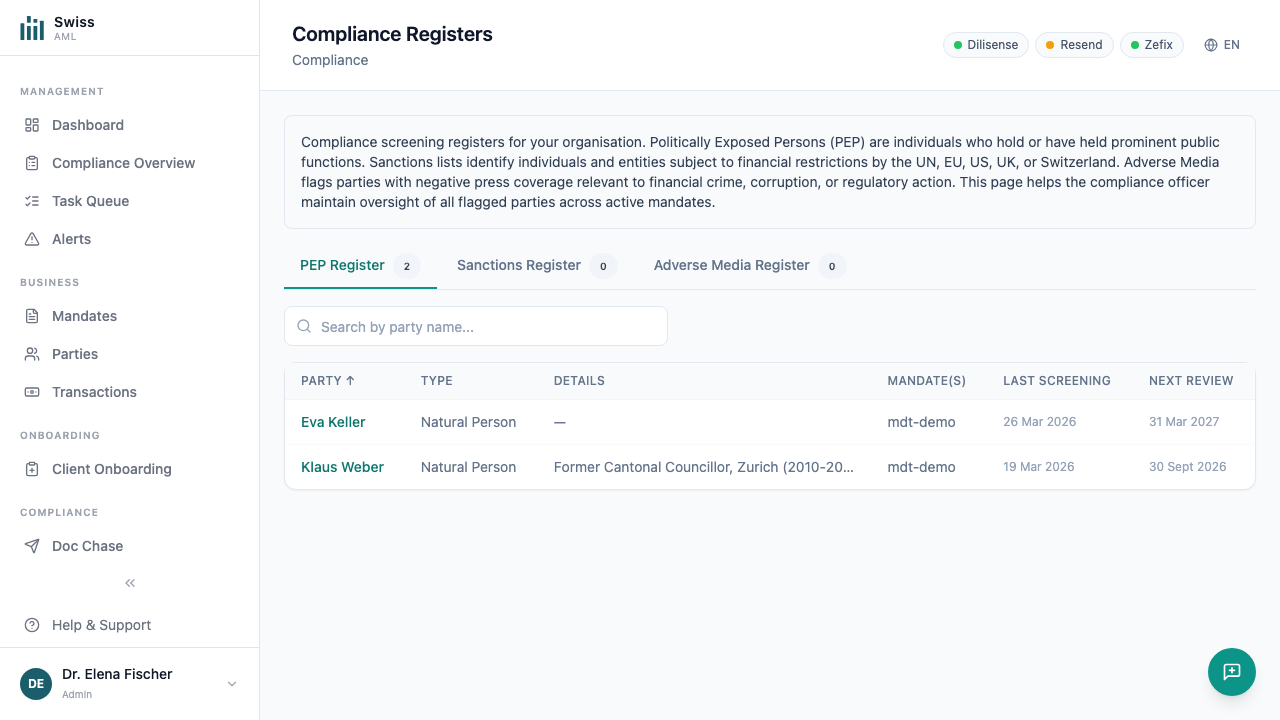
SwissAML maintains three compliance registers: Politically Exposed Person (PEP) Register, Sanctions Register (Office of Foreign Assets Control (OFAC), European Union (EU), United Nations (UN), State Secretariat for Economic Affairs (SECO) lists), and Adverse Media Register. All registers are powered by Dilisense integration with live data. Each search and result is logged in the audit trail. Compliance officers can review screening history per party and demonstrate to auditors that checks were performed systematically and at the required intervals.
Anti-Money Laundering Act (AMLA) Art. 6 / Financial Action Task Force (FATF) Recommendation 12 →7. Risk assessment
Automated scoring with compliance gates
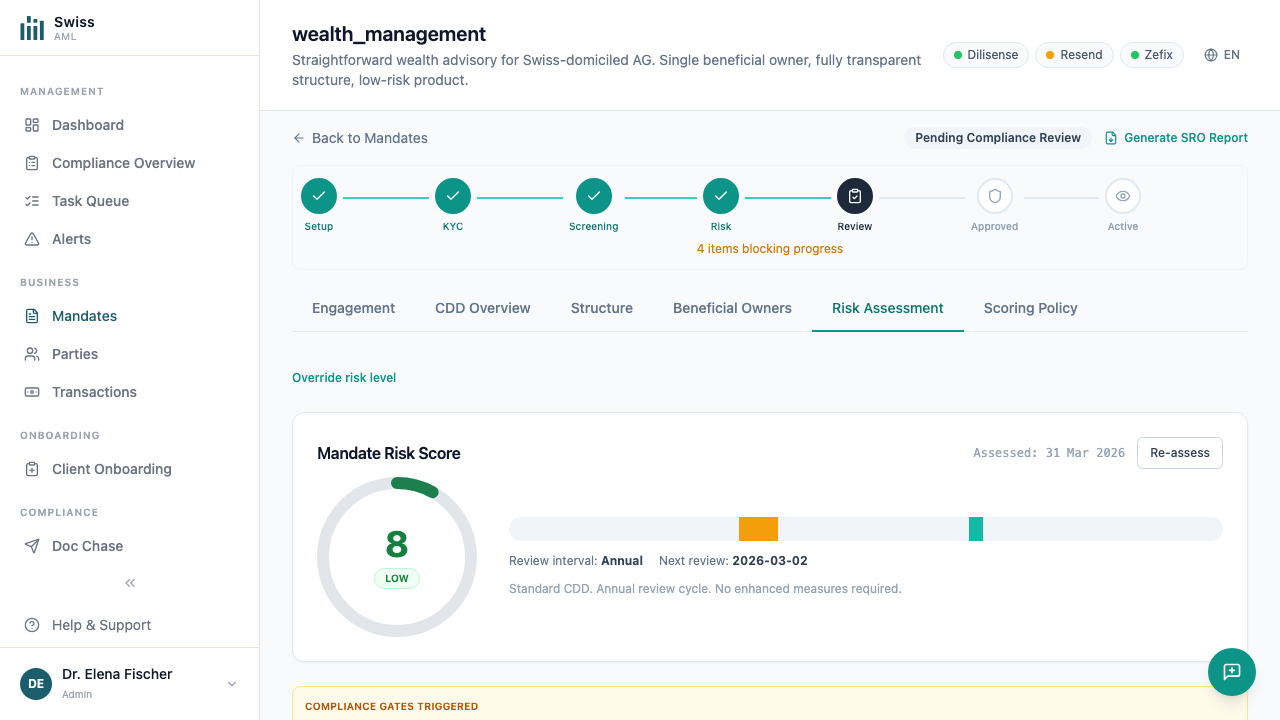
The risk engine scores each mandate across seven factors: jurisdiction risk, ownership complexity, Politically Exposed Person (PEP) status, sanctions screening results, product type, work type, and client profile. The result is a score from 0 to 100, mapped to four risk bands: Low, Medium, High, and Critical. Compliance gates trigger automatically — Enhanced Due Diligence (EDD) is required at score 50+, and senior approval at 75+. The scoring methodology is transparent and configurable, with each factor's contribution visible to the compliance officer and auditor.
Anti-Money Laundering Act (AMLA) Art. 6 / Financial Action Task Force (FATF) Recommendation 10 →8. Regulatory monitoring
Track changes to the laws you must comply with
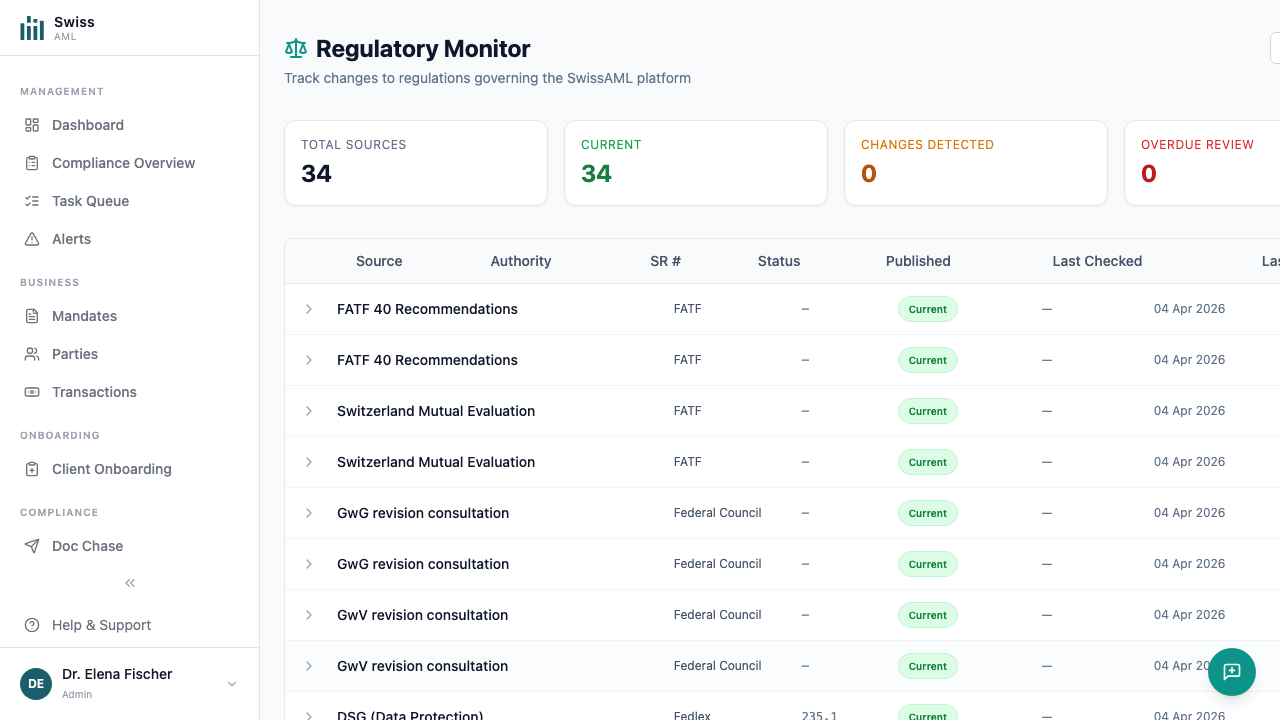
SwissAML monitors 17 regulatory sources including Fedlex (Swiss federal law), Swiss Financial Market Supervisory Authority (FINMA) circulars, and Financial Action Task Force (FATF) publications. When a relevant regulation changes, we generate compliance tasks for affected organisations and create tracking records. Your firm knows about regulatory changes before your next Self-Regulatory Organisation (SRO) inspection, not during it. Each regulatory source is checked daily, and version history is maintained so you can demonstrate when you became aware of a change and what action was taken.
9. Audit trail
Every action recorded, ready for inspection
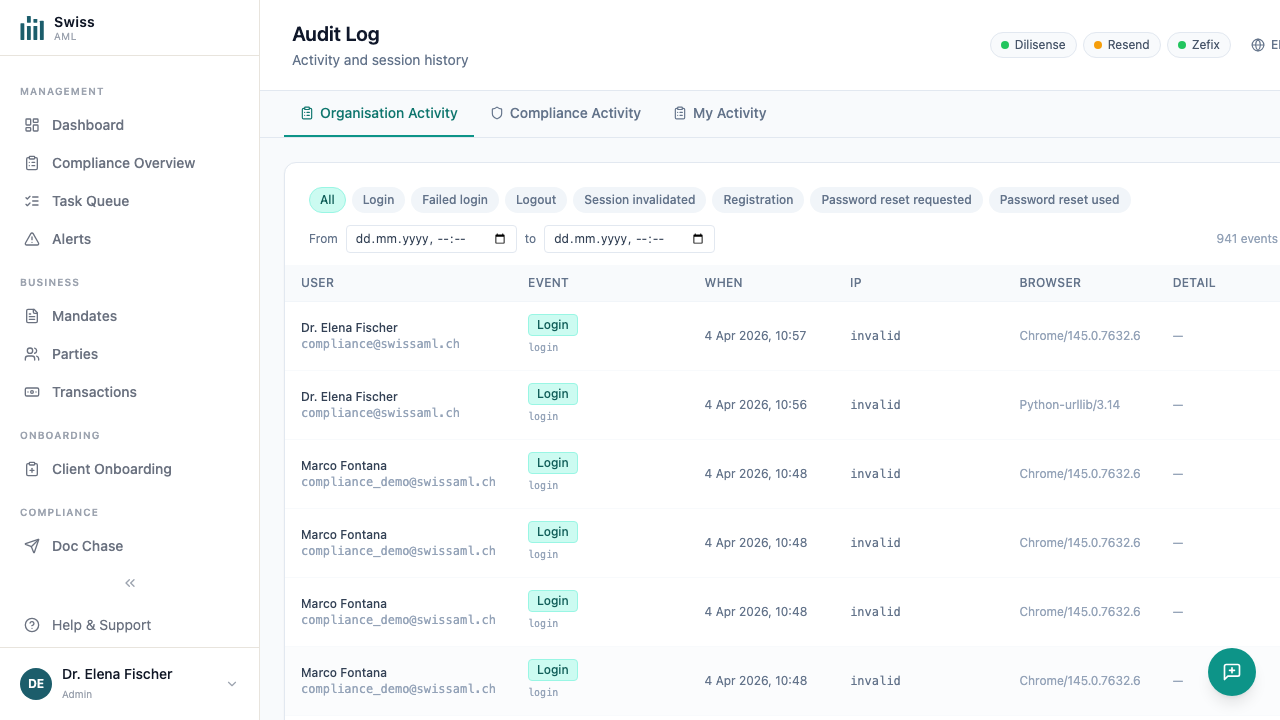
Every action in the system is logged with timestamp, user identity, and IP address. The audit trail is immutable — records can be viewed and filtered but never edited or deleted. Three visibility tiers: My Activity (personal log), Organisation Activity (all users in the firm), and Platform-Wide (for Gottshalden oversight). Session tracking records login times, duration, and concurrent access. Designed for Swiss Financial Market Supervisory Authority (FINMA) examination and Self-Regulatory Organisation (SRO) inspection without preparation — the evidence is always current.
Swiss Financial Market Supervisory Authority (FINMA) Circular 2011/1 →10. Suspicious activity reporting
From screening alert to Money Laundering Reporting Office Switzerland (MROS) filing
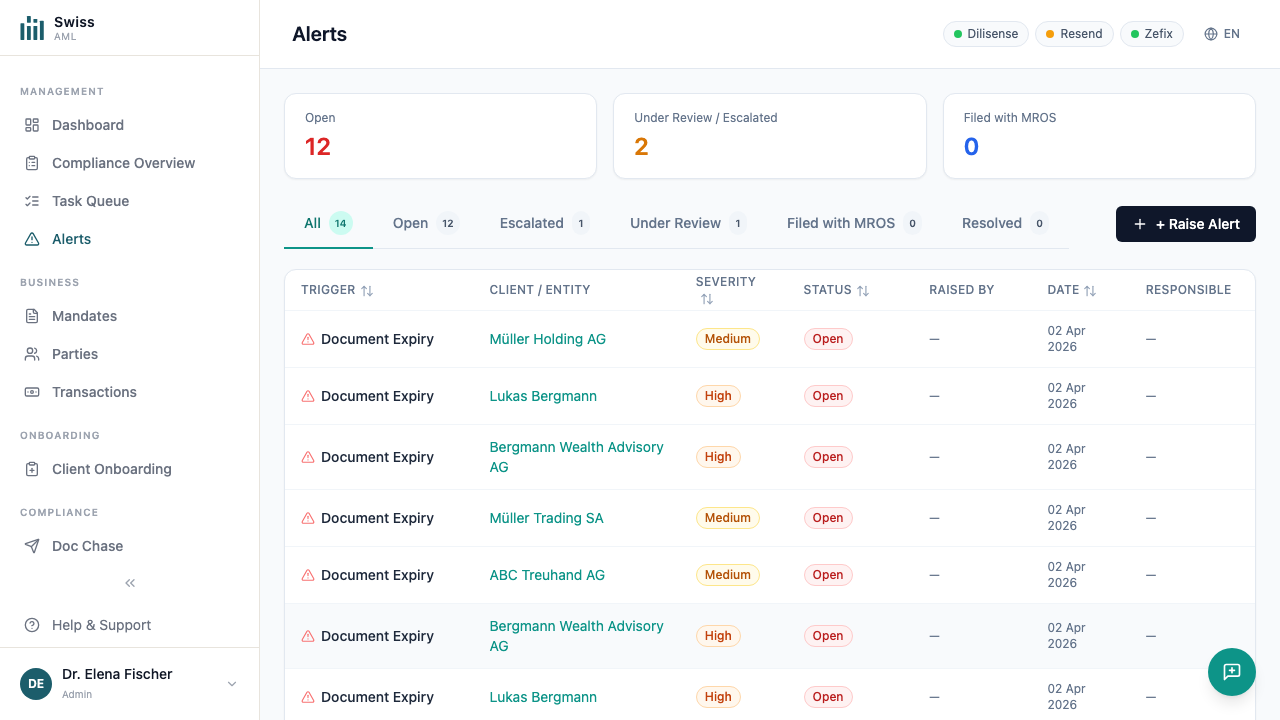
When screening hits or risk factors indicate elevated risk, alerts are generated with a status lifecycle: open, under review, escalated, closed (no action required), closed (resolved), or filed with Money Laundering Reporting Office Switzerland (MROS). Each status change requires a mandatory comment from the responsible officer, creating a defensible decision trail. The goAML XML report can be generated directly from the platform for Money Laundering Reporting Office Switzerland (MROS) filing. Alert resolution is linked to the mandate readiness checklist — unresolved critical alerts block submission for compliance review until they are formally addressed.
Anti-Money Laundering Act (AMLA) Art. 9 →11. Role-based access
Users, roles, and per-mandate permissions
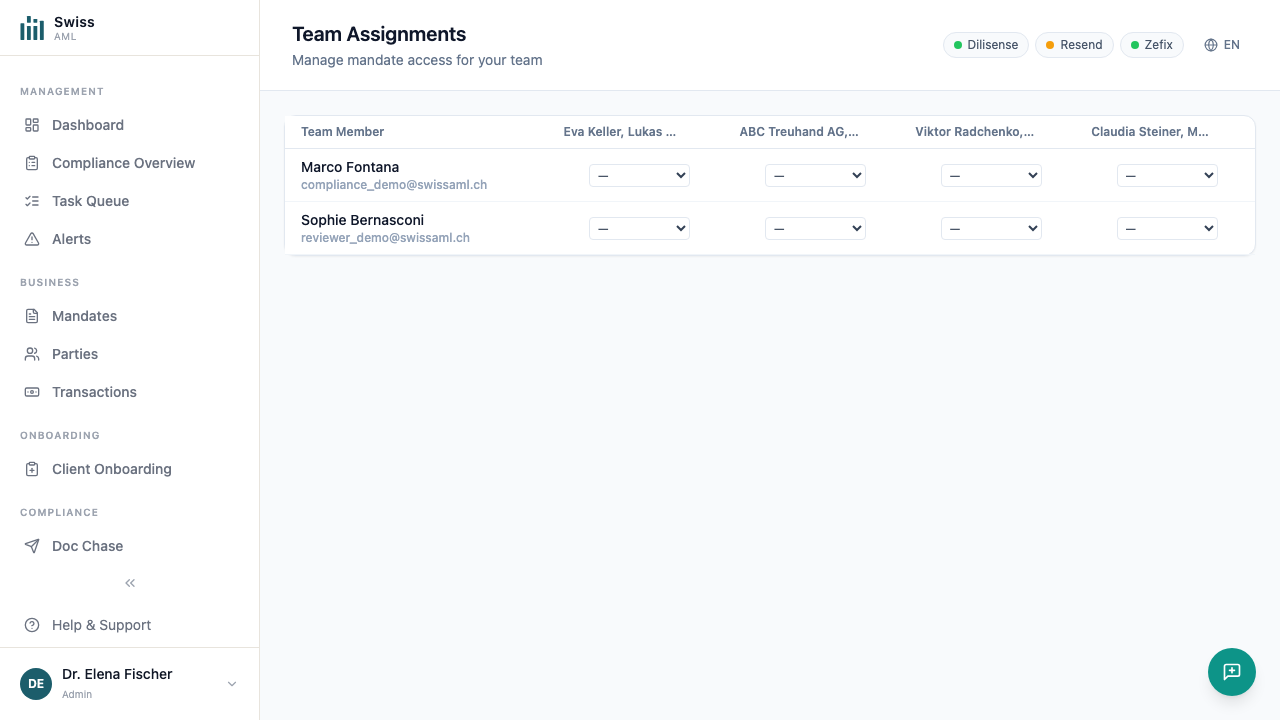
Access is controlled with granular roles: Admin (full access and configuration), Compliance Officer (review, approve, and file), Reviewer (read and comment), Data Entry (create and edit, no approval authority), and Auditor (read-only audit trail access, no client data). Team assignments link officers to specific mandates, and the responsible officer is tracked per alert for accountability. Invitation-based onboarding with activation gating ensures that no user gains access before being formally approved by an administrator.
Per-seat licensing